Firmware alternatif pour lecteur audio portables (DAP) c'est à dire lecteurs MP3.
FOSS


Gestionnaire de bibliothèque audio en CLI
Pour synchroniser de l'audio vers un lecteur audio portable (DAP) utilisant le firmware Rockpod.
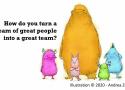
How do you turn a team of great people into a great team? It comes down to a specific set of behaviors.
We can ask for these behaviors, but if we believe in them we have to live them ourselves. And we have to do it over and over.
Here are the behaviors we have found are worth modeling:
Open-mindedness. Suspending our disbelief. Being curious.
Listening with respect.
Speaking with authenticity.
Examining the situation together instead of taking sides.
Learning on company time. Learning in front of one another.
Asking for help. Offering help.
Building a common ambition, and aligning our individual ambitions with it.
Acknowledging others.
Helping others become excellent, even at the expense of our own glory.
Not every behavior will catch on, so pay attention to what does, and turn up the good!
Of course, this works best if people genuinely want to improve. But that is not a deal breaker.
We often don't get to choose who we work with. That's okay. The good news is that there are almost always people nearby who do want to improve. If you're feeling alone on your team, your real challenge isn't convincing everyone. It's finding just a few people who catch the spark. They will become your great team.
Ben Mosior and I collaborated on this.

AI transparency sounds reasonable. But what happens when AI detection and watermarking systems cannot tell the difference between someone generating work with AI and a disabled person using AI as assistive technology?
In this video, I explain why AI watermarking and the EU AI Act have me concerned as a blind accessibility professional, app developer, person with ADHD, and heavy AI user.
AI helps me organize my thoughts, work with inaccessible information, understand images, read documents with OCR, create content, and communicate more effectively. For many disabled people, AI can function as assistive technology.
So what happens when a machine-readable signal simply says that AI was involved?
What happens when a blind person uses AI-powered OCR to read an inaccessible document?
What happens when someone with ADHD or dyslexia uses AI to organize their own thoughts?
What happens if an employer, school, publisher, or automated system sees an AI signal and assumes that person did not actually do the work?
I support transparency and protections against malicious uses of AI. But “AI was involved” does not automatically mean “AI did the work.”
Disabled people need to be part of this conversation while these policies and technologies are being designed — not after they create another barrier.
What do you think? Could AI watermarking unintentionally discriminate against disabled people?
If you think policymakers, AI companies, developers, educators, employers, and accessibility professionals need to hear this perspective, please share this video.




RGESN et marché public
I usually do not originate posts. As a public service I thought I would post a few studies, most published and others just articulated on the web, about the effectiveness of AI.
Ford rehires humans after finding AI can't deliver quality
https://lnkd.in/eCi7wyE9, The BBC, Jun 2026
"Corporate leaders are starting to question whether soaring AI spending is delivering meaningful returns," https://lnkd.in/exb3VncU
Uber's COO says it's getting harder to justify the money spent on AI tokenmaxxing. https://lnkd.in/giMSMnYC, Business Insider.
Microsoft reports are exposing AI’s real cost problem: Using the tech is more expensive than paying human employees, https://lnkd.in/g3cq95pv, Fortune magazine.
Use of ChatGPT reduces brain activity by up to 55% in college essay composition: https://lnkd.in/eHfTNcwX, Cornell University, Jun 2025.
AI dilutes your ability to retain and recall information. ChatGPT: The cognitive effects on learning and memory, https://lnkd.in/e95ZCR2b, Chinese researchers
Doctors' use of AI erodes their own ability to diagnose tumours. "Endoscopist deskilling risk after exposure to artificial intelligence in colonoscopy: a multicentre, observational study."
https://lnkd.in/egGaQgAT. The Lancet digest of medical journal publications.
AI dilutes critical thinking: "AI Tools in Society: Impacts on Cognitive Offloading and the Future of Critical Thinking." https://lnkd.in/ePjS3UZG, Sept. 2025, SBS.
Devs predicted they would be 24% better but in fact were 19% worse: the METR study. https://lnkd.in/e-5SGtwW
AI prompters may be productive, but at the cost of quality: maintenance and repair costs more than eat the advantages. Scientific American. https://lnkd.in/eHsShjzv.
AI-generated "workslop" is measurably destroying productivity. Harvard Business Review. https://lnkd.in/eUyx5t5K
Microsoft found that Copilot 1. made developers feel they were getting more done, 2. gave little to no productivity gain, and 3. increased bugs. https://lnkd.in/ec6ZqpJ8. The BBC, June 2026
Bain & Company research finds AI causes a 10% to 15% hit. https://lnkd.in/e3V87F3i
For the layperson: AI chatbots could be making you stupider. https://lnkd.in/eEVFqJi2, 20 Apr 2026. BBC News.
Cornell University. Scientific American. Harvard Business Review. Microsoft. So many of the positive reports come from sources we should view as untrustworthy, given the posters' prospects of benefiting if AI actually helps.

Felienne Hermans is full professor of Computer Science Education at the Vrije Universiteit Amsterdam.
Felienne is the author of the 2021 book The Programmer's Brain, a very readable and highly insightful introduction to the cognitive science behind how human brains learn programming. Why is programming hard to learn, and what can we do about that, both as learners and teachers? We recommended this for everyone, but it is particularly useful for those who just started to learn programming, as well as people who try to teach others.
Felienne’s most recent project is Hedy, a programming language aimed at beginners – including children – and that realises many of the insights from The programmer’s brain about why programming is hard to learn. Hedy is a “real” programming language in that it is unapologetically text-based, but the language design is gradual, progressing from an extremely lenient but incomplete language to a nontrivial subset of Python.
The language is under active development and constantly exposed to feedback from children who actually learn programming. We find this brilliant and are particularly impressed by the possibility of Hedy to teach some programming to everyone, rather than all programming to some people.
Thinking we have time left to address climate change, or that “Net Zero by 2050” will save us, is driving us toward full social collapse in ways that become more obvious with every new broken temperature record.
Adam McKay
filed 06 August 2026 in CLIMATE CHANGE