Daily Shaarli
August 16, 2026
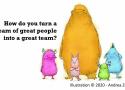
How do you turn a team of great people into a great team? It comes down to a specific set of behaviors.
We can ask for these behaviors, but if we believe in them we have to live them ourselves. And we have to do it over and over.
Here are the behaviors we have found are worth modeling:
Open-mindedness. Suspending our disbelief. Being curious.
Listening with respect.
Speaking with authenticity.
Examining the situation together instead of taking sides.
Learning on company time. Learning in front of one another.
Asking for help. Offering help.
Building a common ambition, and aligning our individual ambitions with it.
Acknowledging others.
Helping others become excellent, even at the expense of our own glory.
Not every behavior will catch on, so pay attention to what does, and turn up the good!
Of course, this works best if people genuinely want to improve. But that is not a deal breaker.
We often don't get to choose who we work with. That's okay. The good news is that there are almost always people nearby who do want to improve. If you're feeling alone on your team, your real challenge isn't convincing everyone. It's finding just a few people who catch the spark. They will become your great team.
Ben Mosior and I collaborated on this.
AI transparency sounds reasonable. But what happens when AI detection and watermarking systems cannot tell the difference between someone generating work with AI and a disabled person using AI as assistive technology?
In this video, I explain why AI watermarking and the EU AI Act have me concerned as a blind accessibility professional, app developer, person with ADHD, and heavy AI user.
AI helps me organize my thoughts, work with inaccessible information, understand images, read documents with OCR, create content, and communicate more effectively. For many disabled people, AI can function as assistive technology.
So what happens when a machine-readable signal simply says that AI was involved?
What happens when a blind person uses AI-powered OCR to read an inaccessible document?
What happens when someone with ADHD or dyslexia uses AI to organize their own thoughts?
What happens if an employer, school, publisher, or automated system sees an AI signal and assumes that person did not actually do the work?
I support transparency and protections against malicious uses of AI. But “AI was involved” does not automatically mean “AI did the work.”
Disabled people need to be part of this conversation while these policies and technologies are being designed — not after they create another barrier.
What do you think? Could AI watermarking unintentionally discriminate against disabled people?
If you think policymakers, AI companies, developers, educators, employers, and accessibility professionals need to hear this perspective, please share this video.