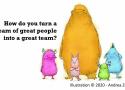
How do you turn a team of great people into a great team? It comes down to a specific set of behaviors.
We can ask for these behaviors, but if we believe in them we have to live them ourselves. And we have to do it over and over.
Here are the behaviors we have found are worth modeling:
Open-mindedness. Suspending our disbelief. Being curious.
Listening with respect.
Speaking with authenticity.
Examining the situation together instead of taking sides.
Learning on company time. Learning in front of one another.
Asking for help. Offering help.
Building a common ambition, and aligning our individual ambitions with it.
Acknowledging others.
Helping others become excellent, even at the expense of our own glory.
Not every behavior will catch on, so pay attention to what does, and turn up the good!
Of course, this works best if people genuinely want to improve. But that is not a deal breaker.
We often don't get to choose who we work with. That's okay. The good news is that there are almost always people nearby who do want to improve. If you're feeling alone on your team, your real challenge isn't convincing everyone. It's finding just a few people who catch the spark. They will become your great team.
Ben Mosior and I collaborated on this.



Key Takeaways
- Pull Request-based async code reviews are a prevailing way of reviewing code in our industry
- When feedback is invited only after making a lot of changes, it becomes very difficult for both the PR reviewer(s) and the author to course-correct and build in quality
- Delays are an inherent property of asynchronous reviews, and they increase PR batch transaction cost
- With small Pull Requests, we lose throughput if we review them asynchronously because delays in communication start dominating PR lead time
- Co-creation patterns, Pair and Mob Programming enable continuous code review which enables both high throughput and high quality
idée de format de kata : "Skill issue"
Basée sur l'idée de "mauvaise foi dans le code, bonne foi dans les tests". (poke @romeu )
Driver joue le rôle d'un agent IA de mauvaise foi.
Driver dispose de quelques fichiers skill.md initialement un peu ambigües.
Driver les interprète de la pire façon.
Ensemble du groupe doit changer ses instructions et/ou les skills pour que Driver fait ce qui est attendu.
Le kata se fait sans L'utilisation de vrai LLM (indeed completion AI)