
Felienne Hermans is full professor of Computer Science Education at the Vrije Universiteit Amsterdam.
Felienne is the author of the 2021 book The Programmer's Brain, a very readable and highly insightful introduction to the cognitive science behind how human brains learn programming. Why is programming hard to learn, and what can we do about that, both as learners and teachers? We recommended this for everyone, but it is particularly useful for those who just started to learn programming, as well as people who try to teach others.
Felienne’s most recent project is Hedy, a programming language aimed at beginners – including children – and that realises many of the insights from The programmer’s brain about why programming is hard to learn. Hedy is a “real” programming language in that it is unapologetically text-based, but the language design is gradual, progressing from an extremely lenient but incomplete language to a nontrivial subset of Python.
The language is under active development and constantly exposed to feedback from children who actually learn programming. We find this brilliant and are particularly impressed by the possibility of Hedy to teach some programming to everyone, rather than all programming to some people.


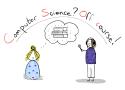
Podcast
by Felienne Hermans & Hanna Schraffenberger
The Computer Science Off Course podcast brings you one paper or book each week to widen your view on what Computer Science is, and what it could be.
Turing, Naur, Dreyfus, Laurel, and many more will bring some much-needed change in perspective for people who grew up on an information diet of only complex algorithms, programming, and math!
Read along with Felienne and Hanna, do the homework and see that there is more between heaven and earth than computers and compilers.
The past 3 years of work in NLP have been characterized by the development and deployment of ever larger language models, especially for English. BERT, its variants, GPT-2/3, and others, most recently Switch-C, have pushed the boundaries of the possible both through architectural innovations and through sheer size. Using these pretrained models and the methodology of fine-tuning them for specific tasks, researchers have extended the state of the art on a wide array of tasks as measured by leaderboards on specific benchmarks for English. In this paper, we take a step back and ask: How big is too big? What are the possible risks associated with this technology and what paths are available for mitigating those risks? We provide recommendations including weighing the environmental and financial costs first, investing resources into curating and carefully documenting datasets rather than ingesting everything on the web, carrying out pre-development exercises evaluating how the planned approach fits into research and development goals and supports stakeholder values, and encouraging research directions beyond ever larger language models.
Chaine youtube qui parle du fonctionnement des algorithmes en programmation, et des technologies sous-jacentes.