
reco #oalbiez



reco #oalbiez
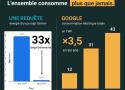
Une requête Gemini consomme 33 fois moins qu'il y a un an. Google consomme 3,5 fois plus d'électricité qu'en 2019.
Attention, exemple d'effet rebond réservé aux initiés. Mouillez-vous la nuque avant de lire, ça peut piquer un peu.
Prêts ?
Google a publié mardi son rapport environnemental 2026. On y lit qu'une requête Gemini pèse désormais 0,24 Wh, une énergie par prompt divisée par 33 en un an. Top.
⚡ Quelques pages plus loin, la consommation électrique totale du groupe : 43 TWh en 2025. Elle était de 31 TWh un an plus tôt. De 12 TWh en 2019.
Multipliée par 3,5 en six ans.
🍃 Les émissions de GES ? Elles ont presque doublé selon la méthode de calcul depuis 2019.
💧 L'eau ? x2 en 4 ans.
La frugalité agit sur les moyens là où la sobriété agit sur le besoin. Google est devenu remarquablement frugal, requête par requête.
Le besoin, lui, n'a jamais été interrogé : des aperçus IA qui s'affichent sans qu'on les demande, de la génération vidéo, des agents qui tournent en continu. Optimiser chaque brique tout en multipliant les briques... à la fin c'est l'effet rebond qui gagne.
L'analyste Ketan Joshi pose la question absente du rapport : si l'infrastructure IA croît plus vite que les réseaux ne se décarbonent, faut-il continuer à la construire ?
Combien de feuilles de route IA reposent sur la même mécanique, en plus petit ?
Comment un modèle ouvert de 35B (Ornith 1.0, MoE), piloté par l'agent open source pi sur mon infra, a écrit, testé et corrigé un vrai projet TypeScript. Verdict : le gap avec les modèles frontière se resserre, vite.

The $20 AI subscription you use every day is a mathematical impossibility. While you enjoy flat-rate access to advanced tools like Claude Code, the raw compute costs for a power user can actually skyrocket to $15,000 a year. We are officially living inside the "AI Uber Moment", a temporary illusion completely subsidized by venture capitalists who are bleeding billions just to get you hooked. But as tech giants resort to hidden financial loops and "stealth-nerfing" your favorite chatbots to survive, the money is officially running out.
Chapters:
- 00:00 - The Trillion Dollar House of Cards
- 00:36 - Chapter 1: The $20 Illusion
- 02:38 - Chapter 2: The Ghost Of Uber
- 05:03 - Chapter 3: The Claude Code Math
- 05:56 - Chapter 4: The Search Penalty
- 08:08 - Chapter 5: The Round Trip Scam
- 09:35 - Chapter 6: The Hardware Debt Trap
- 11:58 - Chapter 7: The Stealth Nerf
- 13:21 - Chapter 8: The 2026 Mass Extinction
- 15:02 - Chapter 9: The Great AI Rug Pull
Narrated by: Josh Risser

Je pense avoir un truc intéressant à dire en réponse à un commentaire de quelqu'un.
Je note l'URL de l'endroit ou se trouve le commentaire.
J'écris ma réponse à part.
Je le garde pour moi (dans mes notes).
Je reviens dessus plus tard (à froid) et je vérifie si c'est toujours pertinent.
Eventellement si je le trouve pertinent, je poste le commentaire.
Ou je le garde dans mes notes.
Ou j'écris un article.
Win win !
- J'ai extériorisé ce truc qui me donnait envie de réagir
- j'ai créé un raisonnement basé sur mon émotion
- mon émotion n'a pas impacté l'origine de celle-ci
- j'ai produit des idées peut-être utiles
- j'ai du contenu à publier

Ma réaction à un commentaire (je ne l'ai pas publié).
@SirBenJamin_ 1 hour ago
In my experience, most coupling problems (and other architecture problems) are caused by teams where everyone works on all parts of the codebase, i.e people don't specialise in a particular area, they just pick up the next ticket on the backlog, and then even worse, other people who also have no experience in the area review the code. Managers will see this as a good thing, as they think they're getting more bang for their buck by 'spreading the knowledge.' ... but I really don't think it ever ends up like that, and the codebase suffers
I think "everyone works on all parts of the codebase" could not be a problem per se if the knowledge is evenly distributed. In very big systems it might not be possible and thus I agree with you that specialization could be an useful strategy. Also, you back this with your experience, so empirical evidence strenghtens your point.
In systems not so big, I think that T shape profile along with good ownership distribution (with pair programming, ensemble programming, ADRs), could also have positive effects on coupling problems. Meaning having knowledge a bit larger than hers scope could help having a glance of neigbourg culture (such as how mapping is done in the team next to me).
Techniques such as "swarming" : helping others being stuck or learning things outside of our initial scope (ex. QA, learning a bit of programming skill, Backend learning a bit of frontend ...) might help growing more shared mental models and thus slowly growing in the direction of full stack profile.
This lovely comic illustrates it pretty well I think : https://blog.crisp.se/2009/06/26/henrikkniberg/1246053060000

Quelques très bons sites et newsletters pour une veille culture numérique technocritique - édition 2025
12 mai 2025
Aujourd'hui plus que jamais, il est indispensable de s'informer, avec exigence, gourmandise et esprit critique (y compris pour penser contre soi-même). Et ce dans tous les domaines. En matière de culture numérique, voici ma sélection personnelle ET actualisée (La dernière édition datait de 2020) de sites, newsletters et podcast permettant de réaliser une veille culture numérique, avec un angle technocritique. Deux précisions importantes. D'abord, cette liste est non exhaustive et sans ordre logique. Ensuite, la plupart (mais pas tous) de ces contenus sont en accès libre, mais pensez à donner à leurs autrices et auteurs, car créer du contenu de qualité représente un énorme investissement en temps !
Podcast
by Felienne Hermans & Hanna Schraffenberger
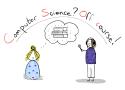
The Computer Science Off Course podcast brings you one paper or book each week to widen your view on what Computer Science is, and what it could be.
Turing, Naur, Dreyfus, Laurel, and many more will bring some much-needed change in perspective for people who grew up on an information diet of only complex algorithms, programming, and math!
Read along with Felienne and Hanna, do the homework and see that there is more between heaven and earth than computers and compilers.
The past 3 years of work in NLP have been characterized by the development and deployment of ever larger language models, especially for English. BERT, its variants, GPT-2/3, and others, most recently Switch-C, have pushed the boundaries of the possible both through architectural innovations and through sheer size. Using these pretrained models and the methodology of fine-tuning them for specific tasks, researchers have extended the state of the art on a wide array of tasks as measured by leaderboards on specific benchmarks for English. In this paper, we take a step back and ask: How big is too big? What are the possible risks associated with this technology and what paths are available for mitigating those risks? We provide recommendations including weighing the environmental and financial costs first, investing resources into curating and carefully documenting datasets rather than ingesting everything on the web, carrying out pre-development exercises evaluating how the planned approach fits into research and development goals and supports stakeholder values, and encouraging research directions beyond ever larger language models.
If you like this Kata, check out another Kata I’ve published using the example of an online car dealership: https://medium.com/nick-tune-tech-strategy-blog/architecture-ddd-kata-online-car-dealership-540c534121e2
If you would like to learn or practice how to break up a large business into domains and use them as the foundation for your software architecture and team organization, I have created a strategic domain-driven design kata that you may find useful. It’s based on the industry of online takeaway ordering and delivery using a fictitious business called Delivericious.
You can find the Miro board here: https://miro.com/app/board/o9J_l45tkpU=/
Stratégie d'accessibilité un sujet que vous ne pourrez pas rattraper sans anticipation, la gestion hiérarchique des expertises. Traduction fiche du gouvernement anglais (#UK).
Dans le schéma pluriannuel d'accessibilité numérique, il y a une partie concernant la constitution des équipes (formations, promotions, embauches...). C'est une obligation légale d'annoncer la politique qui va permettre d'améliorer l'accessibilité.
Souvent, c'est : on a 2 personnes, on prévoit un stagiaire et un #UX ou un #Dev aura une petite formation. Pour un petit organisme, ça marche, mais pour un grand organisme, c'est bien plus complexe.
Si on pose les choses, on se rend compte qu'il faut faire des enquêtes estimer les compétences dans tous l'organisme, embaucher des experts, des auditeurs, former des spécialistes... combien d'#experts, #ambassadeurs pour X employés.
Il faut un référent expérimenté pour faire cela, une personne qui comprend tous les tenants et les aboutissants capable de mettre tout le monde à une place (estimation de l'expertise), prévoir des progressions, prévoir des reconversions, protéger/assister des profils.
Le référent accessibilité numérique va échafauder un plan (qu'il publiera dans le plan d'action) pour gérer les compétences pour le suivi qualité.
Dans le document ci-dessous (publier par GOV.UK), vous pouvez voir un aperçu des types de profils qu'ils ont déterminé et la manière dont ils les ont décrit.
Dans un grand #organisme ça pourrait constituer un plein temps. Alors que souvent il n'y a pas de référent, ou un seul référent peu expérimenté sur ce sujet.
Au delà des déclarations et schéma pluriannuel manquants ; vous pouvez donc essayer de comprendre le retard pris en France sur le sujet, c'est #abyssal.
(Sachant que ce n'est une fois ce plan stabilisé que vous pouvez intégrer concrètement la prise en compte de l'accessibilité dans un système #IA))
Car pour monter cela c'est d'abord du temps, mais aussi des #experts en interne. Et à force de ne pas prendre en compte l'accessibilité en France, des experts ++ en France, on en a presque pas.
Quand la DGCCRF - Ministère de l'Économie ou l'@arcom nous disent faire des contrôles, et progresser... c'est vrai je rigole. Les organismes français écopent le bateau à la petite cuillère.
#WCAG #RGAA #A11Y #Compliance #RH
Simon Bonaventure Frederic Halna A11y France


Key Takeaways
- Pull Request-based async code reviews are a prevailing way of reviewing code in our industry
- When feedback is invited only after making a lot of changes, it becomes very difficult for both the PR reviewer(s) and the author to course-correct and build in quality
- Delays are an inherent property of asynchronous reviews, and they increase PR batch transaction cost
- With small Pull Requests, we lose throughput if we review them asynchronously because delays in communication start dominating PR lead time
- Co-creation patterns, Pair and Mob Programming enable continuous code review which enables both high throughput and high quality
For this online event, we will have the opportunity to receive Dragan Stepanović as a speaker.
After a brief introduction of our community, Dragan will explain the Systems Perspective of the LLM-assisted coding.
Abstract
This will not be your usual "all roses" talk on GenAI nor one that hijacks your amygdala with claims such as "Most developers are going to be replaced by coding agents in 9-12 months!" or "If you don't jump on the train, you're going to be left out!".
For product development teams, organizations, and their customers, every technology they want to adopt, however innovative it is or may seem, doesn't operate in isolation, but as part of a broader system. Ignoring this fact is likely to make things worse instead of achieving the promised huge productivity boost, because any change in a system affects its dynamics in a way that feeds back to affect that change in turn. Some parts of the dynamics accelerate, some start pushing back. It's becoming increasingly important to take a systems perspective on attempts to adopt a technology and understand what desired, but even more importantly, unintended consequences it's likely to cause.
I'll be diving into topics that are likely to stir the pot with uncomfortable, but important questions that a growing number of teams and organizations are facing on this journey. Great, we have this heavy machinery that can produce so much more code in a unit of time, but what do we do with all the piled-up inventory of unreviewed code? What about comprehension debt? How do we keep the ability to reason about the system? Can we replace the process of creating and evolving a product with its output (code)? LLM-assisted vs agentic coding, and which makes sense in which context?
This technology and its adoption are still in their infancy and we're operating in an uncharted territory, so no one really knows yet all the effects that will play out, but looking at it through Systems Thinking, Lean, Theory of Constraints, and XP lenses can provide a useful level of foresight into the distribution of outcomes that might play out.
About Dragan
Dragan is based in Berlin and as a principal engineer helps companies evolve their engineering culture, tame their bottlenecks, and maximize their throughput of the value.
Typically, in search of better ways of working, exploring ends of the spectrum, and helping teams and organizations try out counter-intuitive ideas that initially don't make a lot of sense, but surprisingly end up as completely opposite of that.
He enjoys endless discussions connecting XP, Theory of Constraints, Systems Thinking and Lean.
Retours d'étonnement d'une personne aveugle qui découvre les problèmes d'accessibilité d'un site en quelques minutes. En tentant de naviguer avec les technologies d'assistance.